Global warehousing depends on more than finding extra floor space. It requires a storage method that fits product flow, labor capacity, and changing demand. Drive-in Storage can help facilities store large quantities of similar products in compact lanes. Forklifts enter the rack structure to place and retrieve pallets, reducing the need for separate access aisles.
Warehouse systems expert James A. Tompkins has written extensively about warehouse design and operations. A practical principle aligned with his systems-focused approach is: “Storage density matters only when the goods can still move efficiently.” This is a design summary, not a verified verbatim quotation. It captures an important trade-off. Dense storage can improve space use, but it may limit selectivity and increase handling time. That matters.
For global operations, the right choice depends on the work happening at each site. A distribution hub handling full-pallet loads may benefit from deep lanes and fewer aisles. A facility with many product types or frequent order picking may need more direct access. Local building layouts, equipment, staff training, and operating requirements also shape the decision. Drive-in Storage is not a universal answer. Pallet damage, lane depth, and stock rotation deserve close review before installation. Even a well-designed system can disappoint when daily workflows differ from the original plan. The details are easy to underestimate. A careful assessment of product mix, throughput, and access needs gives decision-makers a more dependable basis for choosing.
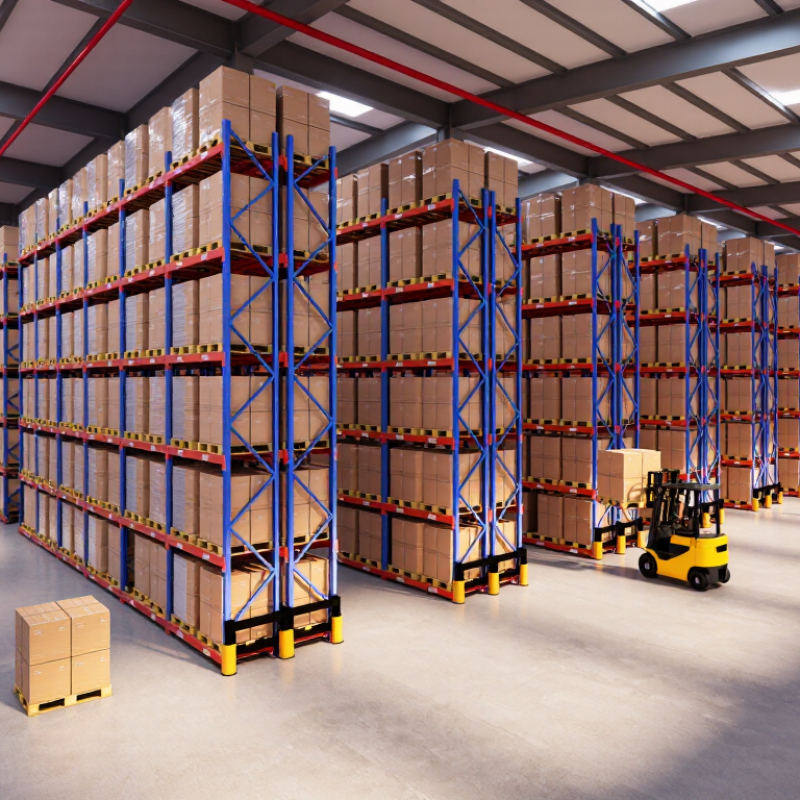
Drive-in racking stores pallets several positions deep on supported rails, rather than placing every pallet beside an aisle. A forklift enters the lane to load or retrieve stock. This design can increase storage density where floor space is limited, including busy regional distribution centers. The trade-off is real.
Most drive-in lanes use last-in, first-out inventory flow. The newest pallet goes in first and sits near the lane entrance; earlier pallets remain behind it. When stock is needed, the front pallet usually comes out first, so the last one stored is also the first one retrieved. This works best when a lane holds one product type and older stock does not need priority.
For example, a warehouse might place identical cartons of packaging materials along a deep lane, with clear labels at the entrance and marked forklift paths. Fewer aisles can mean more pallet positions, but access to individual pallets is limited. That limitation is easy to underestimate. Teams should check stock rotation needs, pallet condition, load capacity, and forklift clearance before choosing lane depth. Global networks often handle varied products and operating practices; one layout may not fit every site. A careful trial with real picking data can expose awkward turns and slow retrieval before expansion.
Drive-in racking stores pallets several positions deep on supported rails. Forklifts enter lanes to place or retrieve pallets. The trade-off is real.
Most lanes follow last-in, first-out flow. The newest pallet stays near the entrance. Older pallets remain deeper inside.
High-volume products with predictable batch movement usually fit well. Reserve each lane for one product type or tightly controlled SKU.
They should not. Blue cartons and green cartons can look similar under warehouse lighting. Separate lanes reduce picking mistakes.
Review stock rotation, pallet condition, load weight, and forklift clearance. Examine real movement data. A tidy lane may still hide old stock.
Use clear lane labels, matching location codes, and scans during putaway and retrieval. Check lanes during cycle counts. Accuracy can decline quietly.
Measure pallet width, depth, total weight, and load distribution. Include the pallet itself. Check rail capacity, entry height, and forklift mast height.
Drawings can miss awkward turns. Mark the lane on the floor and test the largest intended load. Leave space for steering errors and mast movement.
A qualified designer should verify loads, anchorage, clearances, fire protection, seismic needs, and local approval requirements. Do not rely on assumptions.
No. It may reduce aisles but limit pallet access. A small trial using real picking data can reveal slow retrieval before expansion.
Drive-in Storage is a practical solution for global warehousing when maximizing pallet capacity is a priority. Its deep-lane design allows forklifts to enter the rack structure, reducing the number of aisles and potentially providing up to 75% more storage capacity than conventional selective systems. Because pallets are stored in depth, the system typically follows a last-in, first-out (LIFO) method, making it especially suitable for products without strict first-expiry requirements.
Before implementation, warehouse planners should compare pallet standards, such as Euro pallets measuring 1,200 × 800 mm and GMA pallets measuring 48 × 40 inches. Each lane should generally be assigned to one product type to simplify inventory control and reduce handling errors. Rack bays must also be sized for the load dimensions, forklift clearance, and operating conditions. Careful attention to structural capacity, driver visibility, protection measures, and applicable local safety codes helps create an efficient and reliable storage environment.

 Kelida Racking